Tuesday, March 11, 2014

THE DREAM OF THE FOUNDRY


During the time that my  circle was being destroyed by AIDS,  I had a dream of a purgatorial
foundry. It consisted of a vast conveyor belt into the moulten center of the earth, into which  souls went
gladly, to be purified by the fire. This fire was not a hell of eternal torment, but a place of purification.
(The poem I wrote about it--from the vantage of a Charon-like figure who mans the conveyor belt--appears
earlier on these pages, under the title "The Foundry".)

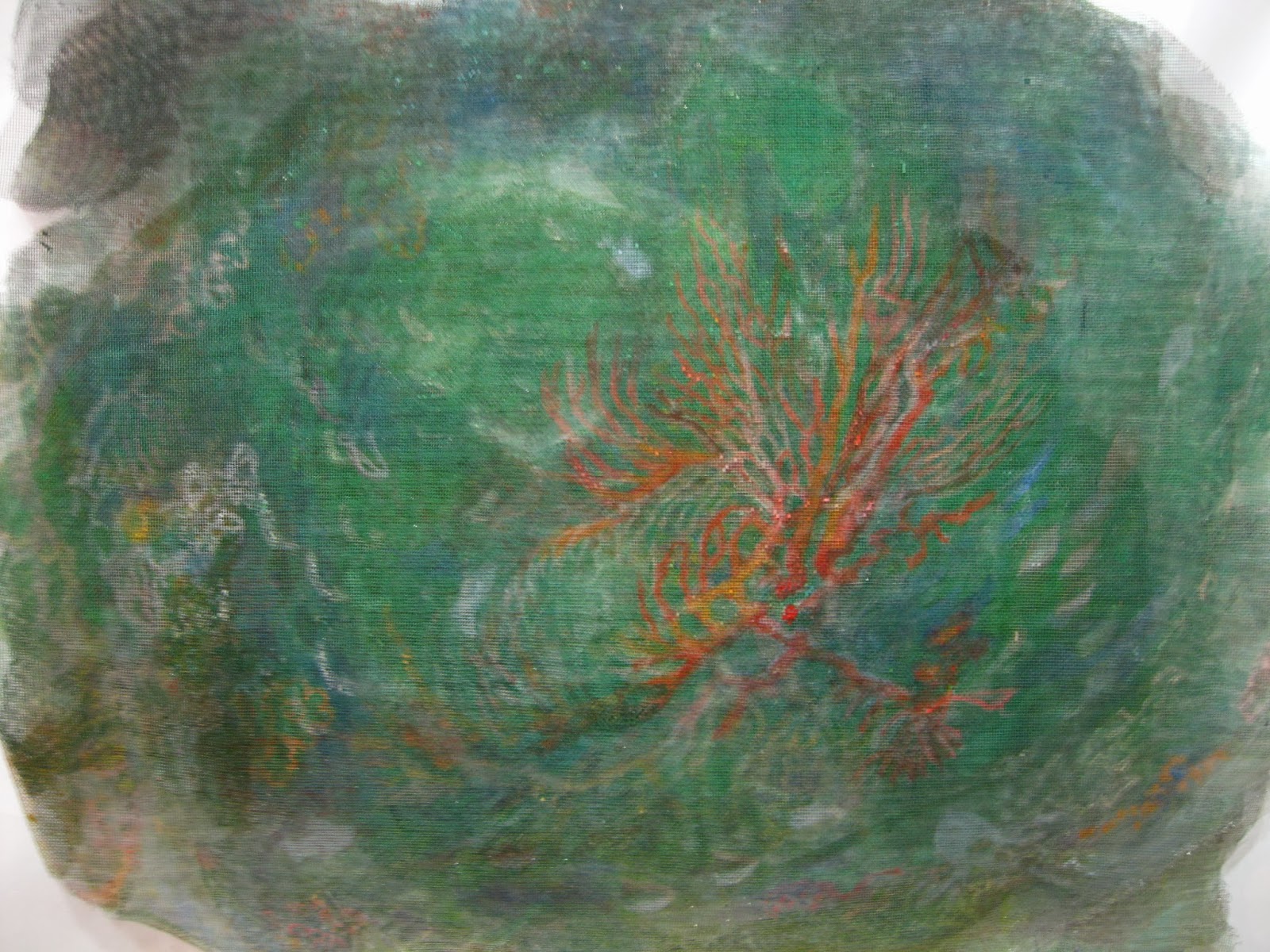
At the same time, I painted a number of works on mirror or glass or mirror and glass into which this dream  attempted to take form. The earliest of these  which survives is  this small piece, twelve inches square, painted on a piece of copper colored mirrored tiling. The straight  lines are  where the mirrored surface appears. My intention was to do a piece which (a) reflected the time of day, which a mirror surely does and (b)a painting in which the viewer may  glimpse themselves. A close examination will yield many fiery figures.Also a ladder of mirror among the flames.


 Another version was on glass and mirror. This is the front panel painted on glass sans the mirror which  reflects the reversed side.
 This is the reverse side, which is a kind of calligraphic skeleton or armature on which the entire painting  "hangs". When it is backed with a second panel of unpainted mirror, it is reversed once again..
 This photograph shows both the two sided painting and the mirror altogether. The two panels are not quite an inch apart, and this process has the effect of  "floating " the painting.
 This is another painting from the same time,  in which I attempted to depict a fiery figure. The front of the first glass panel appears thus.

 But the reversed side is entirely different and is reflected in a mirror. This is, however, complicated further by a second glass panting below the first which is also painted on both sides.
 This is the front of the second glass panel.
 This is the back of the second glass panel.
 This is the three panels together. When assembled, the three panels are about an inch apart, and the painting flickers in  myriad ways.
 The anatomy of this painting is like the one above, and has four painted sides and a mirror.
Here is a detail.


 This is another four sided glass piece. Because it is airier than the previous paintings, I have omitted  the mirror and with it my own inadvertant appearance.
 This is a detail.
 This is another painting directly on mirror. The mirror appears bare mostly towards the center of the piece, but as a linear device throughout. Indeed, it might be described as being carved or incised as much as it is painted. Along with a painting called a "Baroque Mirror"--which will appear elsewhere--it is one of the most elaborate that I did using this technique..
 This is a detail of the center.

And this is a closer viewer of the  left side.
These were an attempt to transistorize the multiple layer technique of my screen paintings, which are my real center, as well as an attempt to make sense of my dream of the Foundry. Let me add that I do not believe that such a dream is meant to be taken literally. It would pain me to feel that I was consigning my dead to the fire. If anything, these were the fires which  I passed through.

(the first painting is 12'x12' and is painted on copper mirrored tile; the second is 8'x 10" and consists of a windowpane painted on two sides backed by a mirror; the following two paintings  are 8 x 12" and consist of  two  window panes  painted on both sides backed with a mirror of the same size; the final painting on mirror is 18''x 25")


Saturday, March 8, 2014

A SUBAQUATIC PARADISE

Most explanations of why an artist does this or that strike me as retrospective wisdom. I can rationalize why
some things bore me and other things haunt me, but I am always aware of something cobbled together
about this. There was,.for example, some childhood festivity-- perhaps a birthday party which misfired--that lies behind my dislike of all things connected with stadiums, mass rallies, patriotism, ideologues, church services, advertisements, conga lines,prayer breakfasts, etcetera. It is why I hate the "Ode to Joy", which seems to me the prologue to a pogrom, though I  revere the Beethoven sonatas and quartets.

But this is to dwell on what I loathe, which is not my intention. The things that haunt me are as enigmatic.
The image of coral gardens which re-appear like a string of islands in  an archipelago through my paintings and drawings probably began
with waking dreams in my early childhood of being under the sea. Was this due to a traumatic exposure to Disney's Pinocchio? Perhaps. But I didn't dream of growing donkey ears, or of other Disney characters--Snow White or Dumbo or Lady and the Tramp.

This buried image quickened many years later--if my recollections don't deceived me--when I was in love with a beautiful blonde socialite, who described scuba diving in the coral reefs of Australia to me.
We also talked that day of the  blues in the stained glass windows of Chartres, which have never been duplicated or equaled ,and these also merged into the image of her as an Aphrodite in the reef-strewn sea.

Two poems which I discovered at that time intertwined  with this image. One was Laforgues' Flora and Fauna of the Moon which Guy Davenport "collaged" into scene of love-making in his  story "The Dawn in Erewhon", and which appears in  his collection TAITLIN. It ends,
                   "We will return and press the question, ah!
                     When we have understood the coral isle."

The other was from Marianne Moore's "Peoples' Surroundings",
                 "And Bluebeard's Tower above the coral reefs,
                  the magic mousetrap closing on all points of the compass,
                  capping like petrified surf the furious azure of the bay,
                  where there is no smoke and life is like a lemon leaf,
                  a green piece of tough translucent parchment,
                  where the crimson, the copper, and the Chinese
                                      vermillion of the poincianas
                 set fire to the masonry and turquoise blues refute the clock..."

These became almost verbal emblems of an elusive image of paradise felt as much as seen, a blue-green
subaquatic world remote from the mundane concerns of Manhattan, which I tried to bring to the fore-
ground of my own imagination. It seems rather grand to call it a "motif"--but what else to call it, though.?
Though my socialite soon went on her blonde way  into circles more moneyed than I'll ever be, she remains more than a memory, a near presence recurring unexpectedly in poems, paintings and
drawings.


(the first image is of a small painting using enamel on copper mirrored tiling; the  following group of three
 images are of a painting/construction done in 2008  using three differently shaped and painted layers of aluminum screening. the first of these three images is of the painting entire; the two after are  of  details.
It is 30"x long by 23" wide)

Tuesday, March 4, 2014

CORAL GARDENS


 Another recurring motif, the coral gardens, for those times that I wished to swim away from sturm und drang
and theology. The  coral gardens were (and are) for me a subaquatic paradise mercifully free of Jehovah
and his surly ways, a dominion (like the greenhouse) of Aphrodite's. Also an opportunity to populate the page with sea creatures, schools of fishes, pagodas of albino white or alizarine crimson--etc.  I trace
the motif back to my earliest childhood, when I  was convinced that I woke up under the sea.

I remember seeing the nightlight sink from view as the walls began to waver and the silvery fishes
flicker into existence as my crib  floated away.  There was the fear of the hammerhead shark
lying in wait down the watery corridor of our house on Perkins street, in Newton, Mass.,
the robed figures ascending and descending the stairway.  (This  may have been the traumatic result
of seeing Pinocchio, with its underwater scenes--I was also persuaded that the spoons and the dishes
held nightly dances on the sly, and that this was something the grown ups had willfully stonewalled
--but I digress)
the first two coral gardens are from 1996, the third from 1987; the theme re-appears in  paintings of mine as well, which will presently appear on these pages.

Thursday, February 27, 2014

FAITH WITHOUT BELIEF:FROM THE JOURNAL OF 1999

Riding  one's own mind---at some point during the day or night I will close my eyes
and view the foreground of thought, which is not thought at all , but a spinning diamond
emerging from the waves or mist in washes of color.

Parked there at the promontory, I will begin to see the light and study it, really, for the
next clue of what to do and how to do it. This is mainly for painting, because the inward
voice to which I used to attend  is mostly hushed now. It does not feel gone, departed,
nor do I feel abandoned as much as at another stage, dry when I was once drenched,
temperate rather than tempest tossed. Is this something to be afraid of?

 Well, I do feel remote, on my own, without mysticism or myth, but retaining some sense
of keeping faith with I know not what. Yet I must keep faith and I will.

Oliver Sacks connects  such idioretinal imagery with migraines, as Hildegarde von Bingen
connected them will mystical ecstasy. I myself connect them with a voyage into some
realm --perhaps my own neurological processes, perhaps the inner locality where
these processes connect with information on the airwaves, television, radio, other
peoples' thoughts--the place where ideas form and alternately disperse.

But here here is no proof or interpretation which can be confirmed or refuted., merely
 myriad  images from which I draw some subject matter and a kind of peace.

I am aware that some call this "God" but I am opposed to calling it anything.
Whatever we call "God" is something more and something less than an entity.
It is not so separate after all, or so different from us, though we are different
from what we think we know.  It will not rescue us from the hands of evil,
or spare us sorrow but it does pose an alternative in the midst of sorrow.
Therefore I may maintain an equilibrium.

2.
There among the tattered blowsy pink romance novels and self help books
and discarded manuals for professions of a Bartleby-the-Scrivener-like inconsequence
at the Library's perpetual book sale is a copy of Rilke's Letters to a Young Poet
to be had for a quarter.

I reread it over a sandwich wondering at the firm belief in the efficacy of solitude and
the eventual arrival of the God to come.

It is enough to make me weep--if I might weep--at the diminished world,
for I have paid the price both in the lawful coin of the realm and in the petty
tariffs excised on the backroads of mere survival. Yes, it is true, I think,
reading Rilke, except in the reckoning of the expense.This can not be known
beforehand.

Remember the little apartment on Golden Gate, that nightly voice always calling,calling
your name, always recognized as hallucinatory, and yet responded to each night
 by going to the window never-the-less? Or those nightmare days following Jamal's death?
This is also the efficacy of solitude.

Those glimmerings of poetry like a gas-jet  burning low are the only consolation--that and
walks in parks where it is always autumn.

Beyond the plate-glass window, it is always masculine and heartily convivial, or
sleek and chic, or clever and deeply profane in a business-like way, for the
whore World must be paid. And there is some illicit relationship between the
gladiatorial spectacular and the grommet counting of slaves but this you will never
comprehend.

And that perpetual sense of a vibration--the gods just about to rain down,
cleansing the picture--will not keep you fed. For that you must scrub pots and
crockery, and then  footwearily  tread a narrow stair,, or shovel gravel all the day. This is
also solitude.

What Rilke could not do was abolish the coin of the realm, and all the transactions
connected  with it.

Now I find a beauty in the onerous, and no longer care--not perpetually,
though there is a wist--for the absence of an interlocutor or perfected understanding.
.
Yes, we would be understood, and on our own terms, and in our own language
--but this is a chimaera, and will not come. To know this and try to act with loving
kindness, even to smile, and be amused, is what I try to do.
Is this the God to come? Not quite.

3.
Not quite, because as much as one would stand outside of time, this is
merely the illusion of a mood, an attitude, and one is in time all the while
and of it. The ruin is not atemporal. It can crumble further, and it will. I, too,
 will vanish.

Nor would I want an eternal life if it consist of my limited self,
my personality, my foibles. My memories would be insufferable stretched
to eternity, like a rubber band spanning the equator.

Fortunately, memories are eclipsed by others. I behold who I was then
and wonder.

Or rather, I wonder at why this or that would have shaken me, why
love was such a flagellation, and grief paralysis, and delusion rife.
Why I placed trust in something I inwardly knew to be false and then
was disappointed.... Misplaced faith I wonder at, and the haplessness
of Rilkean solitude, waiting for the angel on some cold concrete bench
the fallen leaves of November at one's feet as practical matters are
engulfed in a whirl pool  and sink.

 Letters unwritten and letters  un-mailed I wonder at,too, and the weird
variety of omens fabricated from cracks in the sidewalk or a scrap
of newspaper  momentarily whirled upward by the wind while in flight.
 Music heard as an unearthly  visitant, the step on the threshold foretold
--never to fall-- I recall from a thousand times. It had meaning ,yes,but
 no interpretation was  true. Landscapes that seemed to open onto
a new era closed as I passed through. It was a glory to behold them
 but not mine 

Saturday, February 22, 2014

THE DZHIR DRAWINGS :A STORM OF THE SOUL

I have been asked about the early  sources of these Dzhir drawings.  To begin with,
the study of Leonardo's deluge drawings--which I was fortunate enough to  see when they were brought to  the Metropolitan Museum. I was especially fascinated by their seeming to animate before my eyes,
and I studied the currents of the Hudson River, and the breakers of the Atlantic, trying to ascertain how Leonardo had done this.
 Kenneth Clark, in his monograph on Leonardo, supposes that Leonardo saw faster than anyone else.
 As a result, for a while  I tried to speed my sight, but this proved unavailing. Then, I began to practise seeing more and more slowly. Over time, I learned to slow my heartbeat, and my breath, and view a rising falling wave in increasingly slow motion. Then I began to X ray the wave--to see(metaphor) the ball bearings beneath its back and forth.

 This procedure lead to other experiments, which I will describe elsewhere. The main thing was that the study of Leonardo's drawings was  where I began. At some point, the deluge became metaphoric for me, unlike Leonardo's hydraulic studies, for example. Instead, I found myself depicting a storm of the soul. 

This drawing is from   July  1998,  the same time as  most of the previous drawings in this series of   little essays. The first  photograph is of it in its entirety; those after are sectional details. 

Thursday, February 20, 2014

THE WARDROBE


After your family left,
  taking what of your strange estate
    would precede your pale bones home
after I loaded their station wagon,
   and we wept a last time together,
     to wave them--an airplane was waiting--
off, into the blue dawn,
  I folded what remained of your wardrobe
   (most of it;they took
     only what wouldn't need ironing,
leaving the silks and linens, the "natural
   fibers " you prized so much behind)
   the shape of you was still in them,
the fedora, the elegantly creased trousers,
   and almost as if to amuse ourselves
     I began to try them on


Behold me,then,
   as the mirror did, sadly
  assuming your various  personae
with scant success, one by one,
   missing your snort of derision
    at my metamorphoses, only partial,
into a Regency rake in brocade,
   a teddy-boy by the docks
   (how thin I had become
these last months, if not yet
   as weightless as ash)


Taking solace, none-the-less
  in the vain hope of a new life
   that a change in costume implies,
gradually in the process of wearing you
  I discovered a face in the mirror
    neither quite mine or your own,
one to be cruised in the shade or  the alleyways
    while remaining aloof, elusive,
     making an internal tally
of the arrows which fell at my feet
   deflected (by you.?) into a smokeless  pyre


During this period,
   the living involuntarily testified
    to the theory that there is little difference
between the lands of the living and the dead
    (else the partition had grown thin)
    Certainly, the monologues of my acquaintances
said verbatim as if replayed on a gramophone
   ( whether about real estate
      or how many angels might reel
      through a needle's eye)
provided no comfort,
   equally irrelevant was theology,
     styles of steles in pallid Elysium,
the mud huts and razored walkways
   of the Enuma Elish
for all the while your boots
   made their same singalong
    clippity clop


In them, I found myself circling
   the dubious precincts
where the disconsolate go searching for love,
   bars where they gathered
   to ignore each other
in favor of an imaginary ideal,
   Or  down the much  trammeled coverts
    where hidden orgies are,
watching  them,untouchable,
     more of a ghost than a voyeur
knowing that you'd been there before me,
    the direction  remained in the soles of your shoes


Gradually,  they wore out
 nor did I take them to the cobbler,
   items flamboyant
   were replaced by the functional,
others were lost--socks first--
    or went to Goodwill,
what remains I wear
   now and then as a souvenir
of the synthesis of our karma,
    however incomplete


Writing you from another coast,
   almost another country,
I find little else to report,
   save a dream of a room
    --a huge closet--
where you lingered
   both a child and a garment,
    waiting to be worn,
looking forlorn and lost,
   yet someone
   was coming to fetch you,
your waiting was done,
  whether to clothe you
   in flesh again or usher you
 to the circles of light
   I can not conjecture,
only that when the door opened
    you shone.

And I, arrested
   for a while in the half-life
   have started to love again,
and therefore ask your blessing,
    for purgatory
is not a place, as you know,
    but a need like fever.
 
(1992;the photograph is the hand of Paul Thek by Peter Hujar)


Wednesday, February 19, 2014

DUST ON THE TAIL OF THE BIRD OF THE SOUL:THE DZHIR DRAWINGS

'"Praise to the Holy Creator, who has placed his throne on the waters, and
who has made all terrestrial creatures. To the heavens he has given movement,
and to the earth uniform repose...
"In the beginning he gilded the stars, so that at night the heavens might
 play tric- trac.
With diverse properties, he endowed the net of the body,
and he has put dust on the tail of the bird of  the soul."
                                     (from the opening invocation of The Conference
                                          of the Birds by Farid ud- Din Attar)


In 1988 my friend Robert Reese, who had been a lover in my youth, and who remained
one of my dearest friends, began to show signs of  the dementia which foretold his death.

 We had just moved into a spacious loft on the edge  of Bedford/Stuyvesant
in Brooklyn, which was then a dangerous neighborhood. It was the dead of winter,
and  a week after we had moved in, I counted nine bodies in body bags on the street
one morning--and  there they remained  for several days, despite the proximity
of a police station.

Robert, who was half-Mexican, half Chinese, was a beautiful man. He had worked
up the social ladder by  hustling, and through his superb skills as a chef. It
was perhaps an anomaly in  his life that he loved me, and I him, but it was an abiding
love. He would sleep on my pillow when I was away in the country, and describe
the drawings that I did while I was away before we viewed them together. What
was uncanny was how well he intuited them. ..

These were the Dzhir drawings which I have described elsewhere. Members of my order--
the Helveti-Jerrahis--were proud  of  their skills in the interpretation of dreams,
and in fact have claimed to be the "dream order" ( though I have heard Sufis from
other orders say the same thing).  Whether it was due to sleeping on my pillow,
or the drawings that I did to the Sufi Dzhir, or because Robert was being
claimed by Nuredden Jerrahi, the founder of the order--as Sheikh Nuer(the late Lex Hixon)
strongly asserted --I can not conjecture. But Robert began to have highly charged dreams.

He dreamed that he was standing on the summit of a high mountain when the stars were
first set out. Robed figures surrounded his corpse in another dream, and replaced his
 lifeless heart with a beam of light. He also dreamed of  halls of jade and purple, and' sketched
domes under which these dreams were conducted. I remember him in his silk kimono,
his dream  notebook  inches from his face as he would write down these dreams
with his hefty Mont Blanc pen, just after he first woke---he was quite myopic without
 his contact lenses

 All of this dream activity was highly  uncharacteristic of him, it must be said.. Robert
 loved haute cuisine, Ella Fitzgerald singing Cole Porter, expensive accessories, gossip,
 intrigue, and erotic refinement.

He read Balzac, Colette, cookbooks--whose recipes he could recite verbatim--and
 Waverly Root, but never a scripture.

He also dreamed that he was a beautiful female vampire in a couturier gown, who
was pursued  by angels, who reluctantly spread dust on his/her train to halt him.

I somehow sensed when he told me this dream, that he had carelessly transmitted
 the AIDS virus to some of his many lovers.

Someday, I will tell the story of  Robert's death, which was  to happen some six months
after this dream. In the meantime,  after a peculiar waking vision,
he took hand with my Sheikh, and joined the order,and soon after became increasingly
 violent and erratic--at one point attempting to murder me-- and never entered the
 Tekka again.

 Despite this, I could not abandon him, and I am glad I did not.

I  have resolved not to interpret the mysterious connections at work during that
time , which I am sure would lead forthwith to delusion and absurdity. Let someone else
convert a  dream into a doctrine.  I am content  instead, to accept the paradox
 that   grief  requires us live more intently.
And whenever I have done a Dzhir drawing since, the prayers --which are a remembrance of Allah --are also done  in the memory of and  in some wild surmise of hope for  my  friend.


(this drawing, from 1998, is shown in its entirety in the first photograph, and in  sectional details  afterwards)