Tuesday, March 25, 2014

BLACK DRAWINGS

Throughout the  later 1980's, I had  drawn to the recitation of the 99
names of Allah, but there was a time c.1991 when I  changed practise. Instead of an impeccable technique in ink,
I would  "break my hand" and explore  awkwardness, color, and a  black ground. In retrospect, I can see that it was an
attempt to integrate the sense of lose, both of my friends lost to AIDS, and  the
distance I had put between myself and the Sufis. These drawings, done in pastels, became a kind of journey into the
underground. They are not without a certain humor, however,  and I executed them at a clip, often eight or so in the span of a day.  I  have destroyed a great many --a number were later  turned into constructions . Fifty or so have survived
destruction, of which these are a sample. 

one of the problems I was working on was color separation--a printer in Oakland had asked me to devise
something which might be reproduced, and it was my notion to  print something like this drawing or the one before it on black vinyl insect screening .

another question was whether antithetical compositions could be put on top of each other

there was also the attempt to record the after effect of the deaths  where I had been  in attendance--so that this  drawing is almost an image of a journey through the land of the dead for me.
this would be the altogether happier subject matter of creatures at ebb tide by he sea
or Poseidon and a Nereid. The subject matter of the underworld--or Nekuya--re-appears below.
Looking back, I see the struggle between the pull to oblivion and an inherent joi de vivre.
                 This is common to everyone, I now know.
                                                 (a "snow drawing")
                                   (a " sex on the couch" drawing)
(a "rumble")
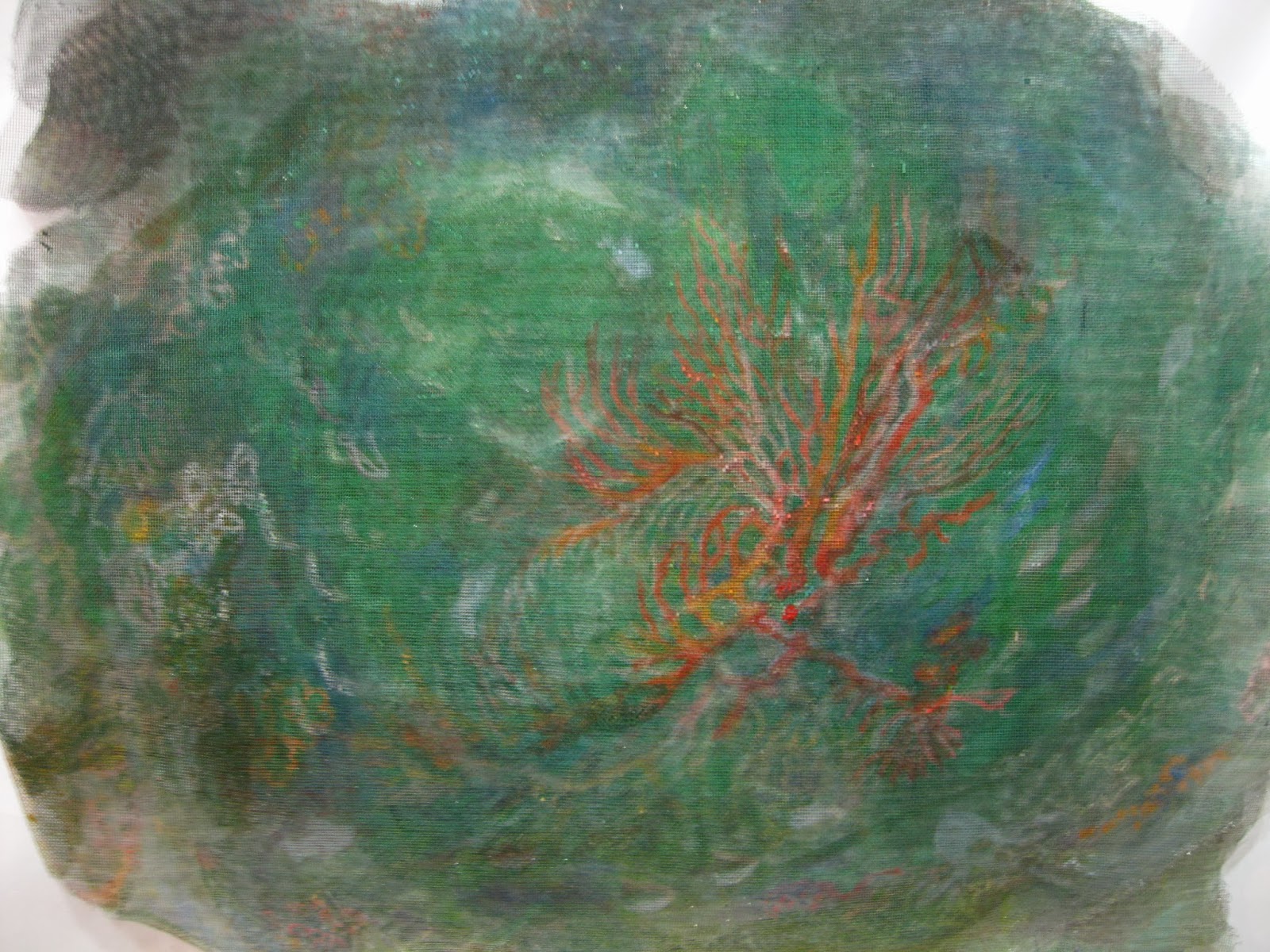
                                                         (a coral garden)
                                             (a coral garden lite by a half moon)

Thursday, March 20, 2014

HOW ONE THING TURNS INTO SOMETHING ELSE (HEBE)

The paradox of flowing drapery rendered in marble has always seemed sexy to me.
It is actually a multiple paradox (or paradox multiplied by another paradox and yet
another). There is the rendering of the impermanent into the" permanent"---  the
 human form into statuary--- the suggestion of nudity by way of drapery--
the flowing by the motionless-- the  fleeting moment frozen in time---poor.Hebe will never
undress.

 It would almost seem that such a statue  is upheld by the interplay of crisscrossing
paradoxes, and that,lacking them, it might topple and fall. It also helps that it
is marble.
.
To extend  these paradoxes further by transforming a sculpture into a painting, a painting
 into a construction,an academic work into an experiment , was my purpose in adopting
Canova's Hebe to a four layered aluminum screen painting.

There was also the sexiness of flowing drapery, in marble or not.


I choose Canova's "Hebe"-- she was the Roman Goddess of Health--because Canova
has always posed an additional puzzle to me, that  of an artist whose technique
 outstrips his affekt,  whose parts are superior to the whole.
He is sublime at drapery, but deficient in feeling.
(It occurs to me now that another paradoxical premises was at work--that of
reconstructing a statue from  its photograph)

The first three photographs illustrate the screen painting version. What a photograph can not convey is
 how the shimmer among the four images--one on each layer-- seemingly billows and  ripples with motion.

The  photographs below
illustrate the two constructions--or free standing sculptures--- made of a four layer
painting on screen from a photograph of a sculpture. The first of these attenuates a
"Canova "into  a "Giacometti,"..

 I am not quite happy with the third and may change it into something more like a relief..
(It  might thereby  fall into the category of a Nereid.)


(These were done in the spring of 2009; the painting is four layers of screen and is 2' x2'; the "giacometti" Hebe is 8 inches wide and 22 inches tall; I am  revising the last piece somehow and have no idea of what will happen yet )

Tuesday, March 18, 2014

A POEM OF THE GREENHOUSE

In this vast alphabet
   of  forms we wander
wondering which
  of our charges--ranging
  from camellia japonica
to araucaria--
  wants water,
if Japanese beetles
  attack the neurasthenic roses
   in our care
or pillage the plum,
if the hydrangeas
  on the hillside
wilt in the June heat,
or, conversely, in winter
  if the ornamental quinces
brought outside on a mild day
  must be wrapped for the night
when February turns frigid.

Never-the-less, despite
 the sometimes seemingly
  continual sense of emergency,
the rigid
  Linnaean nomenclature
  not to mention a clientele
rich in idiosyncrasy,
  some immune
  to the simplest instruction,
it is beauty
  the more touching
  for being transient,
perishable as a peony
   which seems to shed
  its petals as we watch,
which commands our attention,
  even our wear.

Spading the compost
 into  the clay
until the mixture
  resembles cake batter,
is required if the jasmine
  or gardenia will make a summer
   scent redolent of Eden
or Paradise-- first garden
  and the last.
  Is it  then to be inferred
that a stench
  is required to make perfume?
  So I suspect.
Certainly sweat
  is required, and skill,
also the patient
  calculation of effects
  though nature is fickle,
the weather unpredictable,
  and no reference work
seems to account
  for the anomaly
presented by an irate customer
  bearing a blackened branch.

Zigguruts of Babylon
 disappear, the topiaried
knot garden is converted
  into a bocce court
   after the revolution.
The symmetry of heaven
  (where all that is lost
  will be found)
is felt none-the-less
  in an idle moment
  on a hot afternoon
when the flower
 at which we stare
    looks back.

      (1999)


THE GREENHOUSE DRAWINGS

All through my life,  I have worked in greenhouses. The first of these was in California, at Rod McClellan's Acres of Orchids, and then in the plant shop which I ran with my friend, Baruch Himmelstein, in North Beach on Grant Avenue. in San Francisco. We specialized in cacti and orchids.

 Later, I tended the orchid collection of my friend, Nina Reed, in upstate New York. To tend the Vandas,and Oenicium, Cattleyas et al was like being in the sacred Alphabet of Forms. I have worked as a foreman in a nursery specializing in bedding plants, as a garden designer, and as a salesperson in rural nurseries.
 How many trees and shrubs and perennials and bedding plants I have watered is known only to the
recording angel, but if it is to be calculated at a thousand a day--which is an understatement
given the scale of certain operations that I've worked for--then must be a matter of millions. Whenever I have left the business, some prehensile tendril loops me back.
 These drawings are not botanical drawings at all, but memories of the Tillandsias--or tiny grey green bromeliads--at Nina Reed's farm. They were also a nod at the extreme linearity of Ellsworth Kelly's drawings of plants. But some Celtic memory of a carpet page from the Lindisfarne Gospels perhaps intervened. I also do such drawings as a way of elucidating my hand, to draw in a different key, so to
speak, from the drawings done to Islamic Il'Allahis. It is also how my hand wants to draw with a certain kind
of pen, especially when the pen is green. These were done in February 2009.


Tuesday, March 11, 2014

THE DREAM OF THE FOUNDRY


During the time that my  circle was being destroyed by AIDS,  I had a dream of a purgatorial
foundry. It consisted of a vast conveyor belt into the moulten center of the earth, into which  souls went
gladly, to be purified by the fire. This fire was not a hell of eternal torment, but a place of purification.
(The poem I wrote about it--from the vantage of a Charon-like figure who mans the conveyor belt--appears
earlier on these pages, under the title "The Foundry".)

At the same time, I painted a number of works on mirror or glass or mirror and glass into which this dream  attempted to take form. The earliest of these  which survives is  this small piece, twelve inches square, painted on a piece of copper colored mirrored tiling. The straight  lines are  where the mirrored surface appears. My intention was to do a piece which (a) reflected the time of day, which a mirror surely does and (b)a painting in which the viewer may  glimpse themselves. A close examination will yield many fiery figures.Also a ladder of mirror among the flames.


 Another version was on glass and mirror. This is the front panel painted on glass sans the mirror which  reflects the reversed side.
 This is the reverse side, which is a kind of calligraphic skeleton or armature on which the entire painting  "hangs". When it is backed with a second panel of unpainted mirror, it is reversed once again..
 This photograph shows both the two sided painting and the mirror altogether. The two panels are not quite an inch apart, and this process has the effect of  "floating " the painting.
 This is another painting from the same time,  in which I attempted to depict a fiery figure. The front of the first glass panel appears thus.

 But the reversed side is entirely different and is reflected in a mirror. This is, however, complicated further by a second glass panting below the first which is also painted on both sides.
 This is the front of the second glass panel.
 This is the back of the second glass panel.
 This is the three panels together. When assembled, the three panels are about an inch apart, and the painting flickers in  myriad ways.
 The anatomy of this painting is like the one above, and has four painted sides and a mirror.
Here is a detail.


 This is another four sided glass piece. Because it is airier than the previous paintings, I have omitted  the mirror and with it my own inadvertant appearance.
 This is a detail.
 This is another painting directly on mirror. The mirror appears bare mostly towards the center of the piece, but as a linear device throughout. Indeed, it might be described as being carved or incised as much as it is painted. Along with a painting called a "Baroque Mirror"--which will appear elsewhere--it is one of the most elaborate that I did using this technique..
 This is a detail of the center.

And this is a closer viewer of the  left side.
These were an attempt to transistorize the multiple layer technique of my screen paintings, which are my real center, as well as an attempt to make sense of my dream of the Foundry. Let me add that I do not believe that such a dream is meant to be taken literally. It would pain me to feel that I was consigning my dead to the fire. If anything, these were the fires which  I passed through.

(the first painting is 12'x12' and is painted on copper mirrored tile; the second is 8'x 10" and consists of a windowpane painted on two sides backed by a mirror; the following two paintings  are 8 x 12" and consist of  two  window panes  painted on both sides backed with a mirror of the same size; the final painting on mirror is 18''x 25")


Saturday, March 8, 2014

A SUBAQUATIC PARADISE

Most explanations of why an artist does this or that strike me as retrospective wisdom. I can rationalize why
some things bore me and other things haunt me, but I am always aware of something cobbled together
about this. There was,.for example, some childhood festivity-- perhaps a birthday party which misfired--that lies behind my dislike of all things connected with stadiums, mass rallies, patriotism, ideologues, church services, advertisements, conga lines,prayer breakfasts, etcetera. It is why I hate the "Ode to Joy", which seems to me the prologue to a pogrom, though I  revere the Beethoven sonatas and quartets.

But this is to dwell on what I loathe, which is not my intention. The things that haunt me are as enigmatic.
The image of coral gardens which re-appear like a string of islands in  an archipelago through my paintings and drawings probably began
with waking dreams in my early childhood of being under the sea. Was this due to a traumatic exposure to Disney's Pinocchio? Perhaps. But I didn't dream of growing donkey ears, or of other Disney characters--Snow White or Dumbo or Lady and the Tramp.

This buried image quickened many years later--if my recollections don't deceived me--when I was in love with a beautiful blonde socialite, who described scuba diving in the coral reefs of Australia to me.
We also talked that day of the  blues in the stained glass windows of Chartres, which have never been duplicated or equaled ,and these also merged into the image of her as an Aphrodite in the reef-strewn sea.

Two poems which I discovered at that time intertwined  with this image. One was Laforgues' Flora and Fauna of the Moon which Guy Davenport "collaged" into scene of love-making in his  story "The Dawn in Erewhon", and which appears in  his collection TAITLIN. It ends,
                   "We will return and press the question, ah!
                     When we have understood the coral isle."

The other was from Marianne Moore's "Peoples' Surroundings",
                 "And Bluebeard's Tower above the coral reefs,
                  the magic mousetrap closing on all points of the compass,
                  capping like petrified surf the furious azure of the bay,
                  where there is no smoke and life is like a lemon leaf,
                  a green piece of tough translucent parchment,
                  where the crimson, the copper, and the Chinese
                                      vermillion of the poincianas
                 set fire to the masonry and turquoise blues refute the clock..."

These became almost verbal emblems of an elusive image of paradise felt as much as seen, a blue-green
subaquatic world remote from the mundane concerns of Manhattan, which I tried to bring to the fore-
ground of my own imagination. It seems rather grand to call it a "motif"--but what else to call it, though.?
Though my socialite soon went on her blonde way  into circles more moneyed than I'll ever be, she remains more than a memory, a near presence recurring unexpectedly in poems, paintings and
drawings.


(the first image is of a small painting using enamel on copper mirrored tiling; the  following group of three
 images are of a painting/construction done in 2008  using three differently shaped and painted layers of aluminum screening. the first of these three images is of the painting entire; the two after are  of  details.
It is 30"x long by 23" wide)

Tuesday, March 4, 2014

CORAL GARDENS


 Another recurring motif, the coral gardens, for those times that I wished to swim away from sturm und drang
and theology. The  coral gardens were (and are) for me a subaquatic paradise mercifully free of Jehovah
and his surly ways, a dominion (like the greenhouse) of Aphrodite's. Also an opportunity to populate the page with sea creatures, schools of fishes, pagodas of albino white or alizarine crimson--etc.  I trace
the motif back to my earliest childhood, when I  was convinced that I woke up under the sea.

I remember seeing the nightlight sink from view as the walls began to waver and the silvery fishes
flicker into existence as my crib  floated away.  There was the fear of the hammerhead shark
lying in wait down the watery corridor of our house on Perkins street, in Newton, Mass.,
the robed figures ascending and descending the stairway.  (This  may have been the traumatic result
of seeing Pinocchio, with its underwater scenes--I was also persuaded that the spoons and the dishes
held nightly dances on the sly, and that this was something the grown ups had willfully stonewalled
--but I digress)
the first two coral gardens are from 1996, the third from 1987; the theme re-appears in  paintings of mine as well, which will presently appear on these pages.